
The real challenge facing language companies isn’t AI

Table of contents

How agencies manage relationships during this period of transformation will matter more than which technology they adopt.

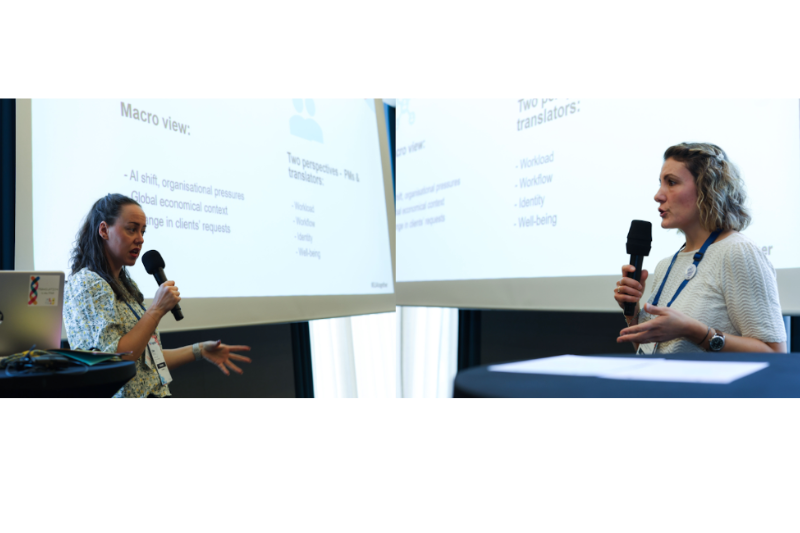
Insights from our presentation at Together 2026 (ELIA), Porto — Anna Fayolle, Translation Team Lead, and Chloe Barton, Project Management Team Lead, Version internationale.

The technology shift is real. But the more immediate challenge for most LSPs right now is relational: how do you hold onto skilled partners, maintain delivery quality, and stay credible with clients, all at the same time?

A survey of our freelance partners conducted before ELIA Together 2026 in Porto put a number on what many already sensed. 45% reported less work than two years ago. Professional satisfaction averaged 5.7 out of 10. The most common word freelancers used to describe their situation was “less.”

The profession is not collapsing. But it is under real strain, and how agencies respond to that strain will define which ones are still standing in five years.

This article covers what the data showed, what we changed internally as a result, and what collaborative change actually looks like in practice.

It is aimed primarily at LSPs thinking through their own approach. Freelancers and clients will find it relevant too: it explains how some agencies are thinking about this period, and what distinguishes a stable language partner from one that is quietly losing ground.

What freelancers are actually experiencing

The numbers from our survey are worth sitting with.

45% of respondents reported having less work. 36% said the nature of their projects had changed. 27% rated their professional satisfaction below 5 out of 10. The words that came up most often, uncertainty, stress, fear, weariness, were not describing a workforce waiting for conditions to improve. They were describing one that is actively recalibrating.

At the same time, the survey surfaced something equally important: adaptation, specialization, training, opportunity. These words appeared alongside the harder ones. The picture is not one of a profession in freefall. It is one of a profession under pressure that is still, in large part, willing to engage, provided agencies give them a reason to.

That condition matters. The freelancers who are adapting, upskilling, and staying in the industry are not doing so passively. They are making choices about which agencies are worth their time.

What freelancers asked for and what it implies

When we asked our partners what support they expected from LSPs, their answers did not focus on volume guarantees or rate increases, two things they largely consider outside their control. They focused on the relationship itself.

Specifically, they asked for clear communication about where the agency stands on post-editing and AI integration. They wanted feedback on their work, not just task assignments. They asked for training, space for dialogue, and visibility into decisions that affect them.

This is not a wishlist. It is a description of what a functioning professional partnership looks like, the kind that existed in many agencies before cost pressure reduced most exchanges to file transfers.

For LSPs, responding to these expectations is not primarily an ethical question. It is an operational one. Partners who feel informed and involved deliver more consistently, stay longer, and handle constraints more readily when those constraints are explained. Partners who feel sidelined look for other clients or leave the industry entirely. The ones who leave are rarely the easiest to replace.

What we changed internally

Understanding the problem is not the same as addressing it. After running our survey, we restructured how we manage change internally, not as a communications exercise, but as a genuine shift in how decisions get made.

The first step was creating space before announcing direction. Rather than presenting a strategy and asking for buy-in, we started with a company-wide meeting, a cross-functional internal survey, and a seminar focused entirely on open expression. The goal was to surface concerns and share ideas before any framework was in place. Change that affects professional identity cannot be imposed top-down. It has to be built with the people it affects.

The second step was treating communication as a structural tool, not a soft skill. We focused on transparency in strategic decisions, clear articulation of priorities, and structured feedback loops, including on well-being. In periods of transformation, silence is not neutral. It gets filled with anxiety and assumption.

The third step was redistributing responsibility. We launched cross-functional working groups, reduced vertical management layers in specific areas, and deliberately delegated ownership of problems to the people closest to them. The outcome was not just better solutions. It was increased engagement and a clearer sense of collective direction.

Internal stability, we found, is not a precondition for adaptability. It is the source of it.
Version Internationale Blog Covers 39

Beyond the agency: universities, clients, and peers

No agency transforms in isolation, and some of the most important work happens at the edges of the organization.

We deepened our collaboration with universities by contributing to curriculum development, teaching, and participating in research discussions. The reason is practical: if academic training programs do not keep pace with industry reality, the next generation of translators will arrive unprepared for AI-integrated workflows. That is a problem agencies will inherit. Contributing to the solution is also self-interest.

With clients, we have invested in direct, honest conversations about where machine translation is genuinely useful, where human expertise is not substitutable, and why quality investment protects their ROI. The race to the bottom that some clients are tempted to run is not in their long-term interest either. Making that case clearly, not defensively, is part of what a strategic language partner does.

With other LSPs, we believe in sharing experience and best practice. The goal is not uniformity. It is a more mature industry, better equipped to have honest conversations with clients and better able to retain skilled professionals.

A framework for leading change collaboratively

Before designing any change initiative, we now ask three questions internally:

What outcome do we actually need? Not the diplomatic answer, the operational one. Reduce turnover by a specific percentage? Retain expertise in a particular domain? Develop a new service line? A vague objective produces a vague change process.

Where is the value we provide, and how can it develop? The question is not how to defend human translation against automation. It is which capabilities, relationships, domain expertise, quality systems, institutional knowledge, can generate services that clients cannot find elsewhere.

Who needs to be part of building this? Change designed internally and announced to freelancers is not collaborative change. The partners who see their input reflected in decisions engage differently from those who receive newsletters.


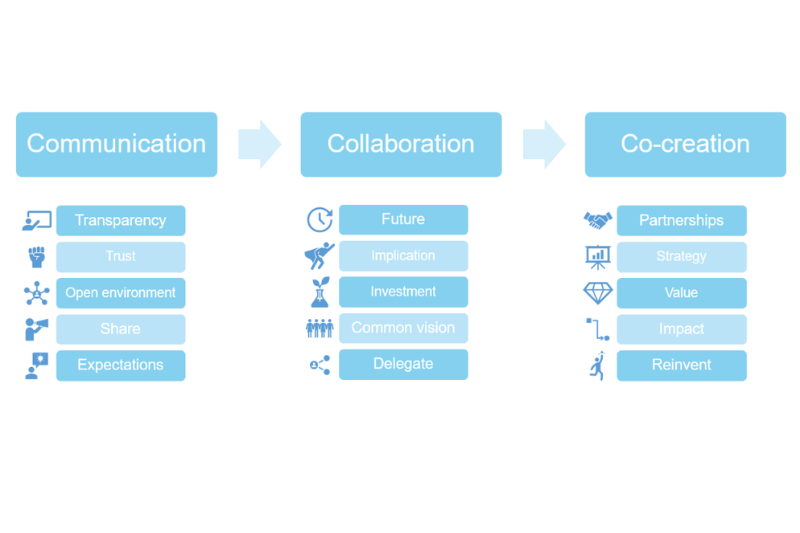
These questions sit underneath the three-pillar framework we presented in Porto:
2

Communication: transparency, trust, and clarity of expectations. Not as aspiration, but as operating discipline.

Collaboration: shared vision, genuine involvement, and real investment in the partnership. Not consultation after decisions are made.

Co-creation: strategy, value, and reinvention built together. The shift from reactive adaptation to proactive positioning.

The progression matters. Communication makes collaboration possible. Collaboration makes co-creation credible.


Why this is a business argument, not a values statement

Investing in collaborative change is not, at its core, about being a good actor in the industry, though it may produce that outcome. It is about building the operational conditions for sustained performance.

Agencies that maintain strong freelancer relationships, communicate transparently, test technology responsibly, and align internally around a shared direction are better positioned across every dimension that clients care about: consistency of quality, flexibility at scale, and cost structures that hold over time.

The alternative, cutting communication to reduce friction, treating skilled partners as interchangeable capacity, adopting technology without managing the transition, is not efficient. It produces attrition, quality variance, and the kind of instability that clients eventually notice and respond to.

Resilience is not a soft concept. It is a performance lever.

The mindset underneath all of this

The practical steps matter. But they rest on a disposition: a willingness to identify problems rather than manage appearances, to stay constructive under pressure, to learn continuously, and to treat colleagues and partners as people whose engagement is something to earn, not assume.

This is not idealism. It is the most pragmatic available response to a period in which isolation increases fragility and collaboration increases the capacity to adapt.

Conclusion

The transformation of the language industry is real, ongoing, and not finished. It is challenging business models, professional identities, and value perception simultaneously.

It is also, for those willing to lead it rather than endure it, an opening.

At ELIA Together 2026 in Porto, our message was straightforward: resilience is not built alone. It is built through communication, collaboration, and co-creation, with the people inside your organization, with your freelance partners, with your clients, and with your peers.

For LSPs, this means leading change in a way that keeps the ecosystem intact.

For freelancers, it means staying in dialogue with the agencies that are trying to do that.

For clients, it means choosing partners who are investing in long-term stability, not just optimizing for this quarter.

The agencies that navigate this period well will not be the ones that found the best technology fastest. They will be the ones that held their networks together while doing it.


Is your agency building the kind of partnerships that hold under pressure?

We work with LSPs, freelancers, and clients who want language services that stay consistent when conditions change. If this article resonated, we’d be glad to talk. 

Share your messages worldwide with perfectly localised and compelling content for a consistent and effective global marketing strategy.

WRITTEN BY
Chloe Barton

Chloe Barton

Chloe Barton has been a Localization Project Manager and expert in transcreation and international marketing at Version internationale for 6 years. With 10 years of experience, she supports companies in the cultural adaptation of their campaigns and the coordination of multilingual projects.

REVIEWED BY
Martin Prill

Martin Prill

Martin Prill has been a Director at Version internationale in Lyon for 8 years, with solid experience in intercultural management, international project management (localization, multilingual team coordination), and operational governance. Trilingual FR-DE-EN.