
For the last few years, the Software-as-a-Service (SaaS) industry has been undergoing a period of profound change, characterized by relative saturation in English-speaking markets and increased pressure for capital efficiency.
According to recent estimates, the global SaaS market was worth around 315-320 billion USD in 2025 and was likely to continue to experience strong growth of around 12 to 20% per year according to sources, to reach around 370-380 billion USD in 2026, under the most favorable conditions.
Against this backdrop, localization can no longer be considered an after-the-fact support function, taking place once the code has been finalized, but must be reinvented as a key driver of international growth and user acquisition.
We are witnessing the dawn of the “Post-Localization” era, a term that encapsulates the native integration of linguistic processes at the very heart of the product infrastructure and revenue operations (RevOps).
This article provides an in-depth analysis of the strategies adopted by the most successful scale-ups to structure their localization.
The real problem: localization seen as a “one-shot” solution
The longstanding structure of localization teams, often part of marketing or shared services departments, has proved inadequate to meet the demands of continuous roll-out.
Over the past two years, organizational models have evolved to embed localization (L10n) and internationalization (i18n) directly into the processes of engineering and product teams.
We are seeing a trend among industry leaders: the creation of the role of Localization Product Manager (LPM) or International Product Manager.
Unlike the traditional localization project manager who supervises translation workflows, the LPM works within product squads and is responsible for the global user experience (Global UX).
This integration meets the critical need for strategic alignment. Nataly Kelly, a renowned industry expert and CMO at Zappi, believes that localization must be seen as a growth strategy directly linked to revenue, rather than a simple cost center.
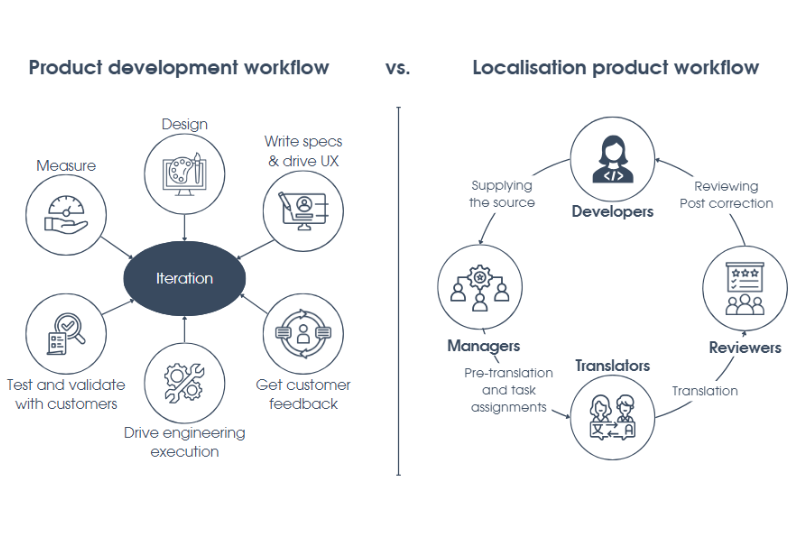
Governance: who is in charge of product localization?
The concept of LangOps (Language Operations), that slowly came to life at the start of the decade, has become an operational reality. It is no longer about managing translations, but managing linguistic data in a holistic manner throughout the company.
In a mature LangOps set-up, the central team does not manually manage projects, but administers the technological infrastructure, which enables other departments (Support, Sales, Product, Marketing) to utilize self-service localization services via APIs and connectors.
This resolves the chronic problem of data silos, in which the marketing team uses different terminology to the product team, generating inconsistencies for the end user.
Furthermore, the large-scale adoption of generative AI (GenAI) and large language models (LLMs) has led to a shift in how teams are put together. We are seeing a change in purely linguistic roles to hybrid technical or analytical roles.
The table below summarizes the change in skills expected in modern localization teams:
|
Traditional role |
New role |
New key skills |
|
Translation Project Manager |
LangOps Manager/TPM |
Automation, Python, API management, BI data analysis. |
|
Translator/Linguist |
Cultural Strategist/AI Auditor |
Post-edition (MTPE), AI quality estimation (QE), prompt engineering. |
|
Localization Engineer |
Linguistic Data Architect |
Model fine-tuning, corpus management, RAG (Retrieval-Augmented Generation). |
|
Localization Quality Assurance (LQA) Manager |
AI Performance Analyst |
Statistical analysis of MQM scores, detection of algorithmic bias. |
Building an agile localization workflow
The 2025-2026 tech stack is defined by its interoperability.
Monolithic translation management systems (TMS) are giving way to connected ecosystems where content flows seamlessly between design tools, code repositories and AI engines.
For SaaS applications that push code several times a day, continuous localization is one option to consider. This is based on the full automation of workflows via CI/CD (Continuous Integration/Continuous Delivery) pipelines. The result: a fluid localization chain that can be managed and aligned with the product roadmap.
At the same time, some scale-ups, such as those using the Localization as Code solution described by Phrase, are aiming for a pipeline where human intervention is minimal. Low-visibility strings are translated by AI, validated by automatic quality scores (Quality Estimation), and reintegrated into the code without manual action. Only critical content or content with a low reliability score triggers a human review task.
Table comparing current leading tools:
|
Tool |
Position and strengths for scale-ups |
Innovations (2024-2025) |
|
Leader in design-led localization and developer integration. Very popular with tech start-ups (Revolut, Notion). |
Advanced Figma plugins with bidirectional visual context. No-code automation workflows. |
|
|
Robust and high-performance business solution for orchestration and analytics (QPS). |
Launch of Phrase Orchestrator for complex workflows and Phrase QPS for AI-based quality scoring. |
|
|
Developer-centric approach, excellent branch management and CI/CD. Ideal for technical products. |
Crowdin AI for agentic workflows and seamless integration with GitHub Actions. |
|
|
Focus on visual quality (Proxy) and detailed LQA dashboards. |
Predictive Quality Confidence Score and granular LQA dashboards for supplier management. |
|
|
Specialist in continuous and native localization (Transifex Native). |
Over-the-Air (OTA) solutions for mobile updates without app s tore redeployment. |
Managing, measuring, improving
In an economic climate where every investment must be justified, localization managers need to rely on hard data. A clear distinction is made between operational metrics (for the team) and strategic metrics (for C-suite executives):
Operational KPIs:
- Time-to-Publish: The time between code push and translation availability in production. Automation aims to reduce this time from several days to a few minutes/hours.
- Automation rate: The percentage of words processed entirely by AI without human intervention. Companies seek to maximize this rate for low-visibility content.
- LQA error density: The number of errors per thousand words, categorized by type (terminology, style, accuracy). Dashboards like those offered by Smartling give an overview of this trend to audit the performance of vendors or AI models.
- TM leverage: The percentage of reused content, directly impacting the savings achieved.
Strategic KPIs:
- Language-Influenced Revenue (LIR): This refers to the portion of revenue (ARR/MRR) generated by non-English-speaking markets or by consumers using the product in a localized language.
- Conversion Uplift: The difference in conversion rates (visitor -> lead -> paying customer) between a localized experience and an experience in a given market. It justifies the localization ROI.
- Retention and churn per region: An abnormally high churn rate in a specific region is an early indicator of poor localization quality or a lack of cultural adaptation.
- Market Penetration Rate: The company’s market share in a target region relative to the total addressable market (TAM), correlated with localization efforts.
Case studies and feedback
An analysis of the strategies recently rolled out by leading SaaS companies has revealed a range of innovative and diverse approaches. Here are two examples:
Revolut:
- The challenge: the Fintech sector requires pinpoint accuracy. A translation error in terms and conditions or a banking interface can result in regulatory penalties or the loss of licenses.
- The strategy: radical centralization through robust infrastructure (using Lokalise) to manage high volumes with extreme speed.
- The workflow: automation via an API enables new strings added by engineers to be translated in less than an hour. At the same time, strict glossary and compliance checks are automatically applied to ensure that financial terminology (e.g. “APR”, “Overdraft”) comply with the local laws in each market.
- The result: this agility has enabled Revolut to quickly launch critical localized features, contributing to strong growth in their customer base.
Canva :
- The challenge: as a design tool, Canva cannot tolerate any visual inconsistencies. Overflowing text or complex scripts can spoil the user experience.
- The strategy: Canva has implemented a system in which localization is treated like code and their internationalization engineering team works hand in hand with designers.
- The workflow: With the introduction of generative AI features (“Magic Translate”), Canva had to ensure that its models were culturally appropriate. The brand rolled out massive automated testing pipelines using visual regression to check the integrity of updates across hundreds of languages simultaneously, ensuring that designers can design in all languages at once without cumbersome manual verification.
Conclusion
Analysis of the SaaS market confirms that localization has ceased to be a fringe task and has become a critical infrastructure.
Businesses that succeed internationally stand out in three ways:
- They do not view localization as a cost or a step, but as a key factor in their scalability.
- They are not afraid of AI, which manages volume and automated quality control, while humans focus on high value-added cultural adaptation.
- They manage localization using impact metrics (revenue, conversion, retention) rather than cost or volume metrics.
For leading SaaS companies, the direction is clear: invest in language data architecture (LangOps), automate visual and linguistic testing, and align localization teams with global revenue targets.
Vous avez besoin de challenger votre chaîne localisation produit ?