
Transcreation, a combination of the words “translation” and “creation”, is a creative process used in marketing.
Going further than translation, which preserves the linguistic meaning, transcreation preserves emotional intent and cultural resonance.
At a time when consumers’ attention is increasingly fragmented by a multitude of competing demands, brands have everything to gain in terms of engagement by focusing on greater cultural resonance and appealing to consumers’ emotions.
Translation is about understanding. Transcreation is about emotions.
When the message gets across but fails to hit the spot
What are the reasons why a perfectly translated marketing campaign struggles to resonate in target markets? When the message is communicated, but the emotions and cultural references have been lost in the process?
This is where transcreation comes into play. It focuses on cultural context, tone, and emotional impact. Without cultural adaptation and all-round emotional communication, your translations will struggle to impress your audience.
To encourage engagement, it is essential to understand the motivations, emotions, and cultural context of your audience. This is the starting point for any transcreation project.
What audiences want: local emotions, universal brands
In a world where brands are becoming increasingly global, consumers clearly expect them to understand and respect their cultural values.
Transcreation ensures that campaigns are consistent across all markets, while tailoring content to the cultural, emotional, and linguistic characteristics of the target audience.
MESSAGE ALIGNMENT + LOCAL ADAPTATION = INCREASED TRUST
This equation increases engagement and takes your campaigns to the next level in several areas:
- Improved cultural resonance: adapting your message to local cultures, values and traditions strengthens trust and engagement. Consumers are more inclined to interact with your brand.
In intercultural communication, for example, we talk about high-context and low-context cultures. In high-context cultures (countries in South America, Asia and many Arab countries), communication is particularly implicit. People use a greater amount of nonverbal cues, social norms, and shared references to convey information. The tone has to be more respectful and the visual symbolism more subtle.
In low-context cultures (for example, countries in Northern Europe or North America), communication is more direct and explicit. Messages are clear, unequivocal and do not rely so much on interpersonal relations. The tone is more informal.
(Source: Contexte et communication interculturelle [Context and Intercultural Communication])
- Preserving brand identity: transcreation ensures that the brand’s message remains consistent and its identity intact, while tailoring its delivery to local audiences. Transcreation specialists harness creativity, linguistic expertise, and knowledge of local culture to capture the spirit of the message and recreate it to convey the same intention and impact.
- Stimulating emotional resonance: every marketing writer knows that emotion drives action. Creating an emotional link with the audience is essential to make a message resonate with the public. By understanding how different cultures express and perceive emotions, you can foster a deeper connection with consumers.
And this gets results: according to a study, when customers feel an emotional connection to a brand, 76% of them will buy from that brand rather than a competitor, and 57% will increase their spending on this brand.
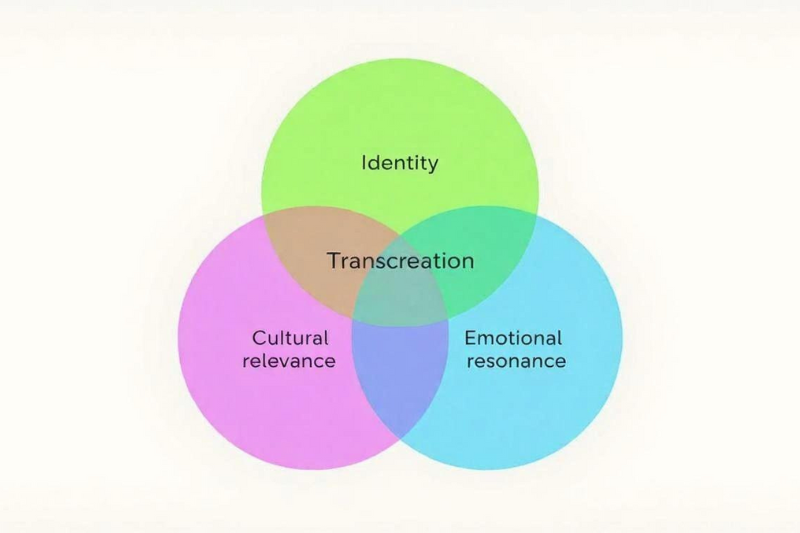
Transcreation: a strategic creative approach for discerning brands
What sets transcreation apart from translation or localization
One of the main challenges for transcreators is finding the balance between remaining faithful to the original message and creatively tailoring it to the target audience. Transcreation recreates a message for a given cultural setting, without losing the essence of the brand.
Here is some information to help you understand the difference between translation and transcreation:
Translation | Transcreation |
Preserves the original meaning and structure | Favors creativity and cultural resonance over remaining faithful to the source text |
The translator works with the source text | The transcreator relies primarily on the creative brief |
More profitable approach | Higher financial investment |
Requires accuracy and respect for the source text | Creative freedom, change of narrative, images, symbols and emotional references |
Makes the content accessible to a new audience | Focuses on public engagement and emotional resonance |
For content requiring accuracy and precision: contracts, compliance, safety instructions, product descriptions, FAQs, privacy policies, etc. | For marketing and advertising, where creativity and cultural sensitivity are essential: television advertising, social media, brand message, slogans, website headings, emailing campaigns, etc. |
Brands that use transcreation as a winning strategy
Certain brands have understood that transcreation is the key to the success of multilingual campaigns. Case studies show how leading brands have used transcreation to solve complex commercial issues, transform their image and break into hostile markets.
Heinz Arabia: Ketchup insurance, or the transcreation of a behavioral insight
Challenge: In 2024, Heinz was looking to strengthen its position in the United Arab Emirates (UAE), a saturated and highly competitive market. The strategy team identified a specific cultural issue. In the UAE, a well-manicured appearance and cleanliness are important social markers. In parallel, ketchup is a product that inherently makes a mess.
Approach: Instead of ignoring this problem, Heinz embraced it. The insight transcreated was not linguistic, but behavioral in nature: “If you’re willing to risk staining your pristine clothes for Heinz, it’s because you love the taste so much it’s irrational.” Heinz Arabia and FP7 McCann Dubai launched the “Ketchup Insurance” campaign. The campaign covered 57 types of claims for ketchup stains. Claims were made via the MyBenefitsapp, a leading employee benefits platform in the Middle East, embedding the campaign in residents’ everyday digital ecosystem.
Result: A spectacular 18% increase in sales in the UAE was recorded during the campaign. Social media engagement soared by 856%, with over 3,000 claims made in the first month.
Nubank in Mexico: Building trust in a society of mistrust
Challenge: Mexico represents a conundrum for fintech companies: a large population that does not have access to banking services, but a historical mistrust of financial institutions. For Nubank (originally from Brazil), breaking into this market meant overcoming this skepticism.
Approach: Nubank rolled out a localization strategy based on social proof, a powerful tool in collectivist cultures with a high avoidance of uncertainty, such as Mexico. The “Pregúntale a alguien” [Ask Someone] campaign rejected institutional self promotion. The message was: “Don’t just believe us, ask your friends”. Nubank also renamed its savings features “Cajitas” (little boxes), a term culturally steeped in affection and simplicity, evoking traditional and informal methods of household savings.
Result: Nubank hit 10 million customers in Mexico in 2024, reaching 14% of the total adult population. 78% of customers live outside the major financial centers, confirming the relevance of simplified and accessible language. Deposits reached 3.8 billion dollars in Q3 2024, proving that trust has translated into real financial engagement.

Where, when and how to transcreate as part of a comprehensive strategy?
Slogans, campaigns, emotional content: high-impact areas
Content with high cultural or creative value should be transcreated as a matter of priority. This includes slogans, creative campaigns, editorials, e-commerce campaigns, social media posts, and more broadly, content intended to develop brand awareness on social media.
Our transcreation expertise applied to B2B campaigns
The Version internationale team managed the transcreation of a marketing campaign that featured several taglines, which were also to be used as hashtags on social media. We had to keep the English-language structure, while preserving the notion of “B2B”, without losing the impact created by these punchy taglines. Here are a few examples of the transcreations dreamed up by the team:
“B2BangForYourBuck” 🡺 “BtoBoostezVotreROI”
”Audiences that hit your B2Bullseye” 🡺 “Des audiences BtoBrillantes”
”B2BoldlyGoWhereNoMarketersHaveGoneBefore” 🡺 “BtoBriserLesCodes”
This type of project illustrates our ability to combine creativity, accuracy, and impact to offer each brand a truly unique transcreation.
The process of transcreation from the brand’s perspective: from intention to impact
There are several key factors to consider when choosing between transcreation and translation:
- Emotional intensity: message relying on feeling, humor, wordplay
- Cultural relevance: targeting of markets with considerable cultural differences
- Type of content: social media, advertising, brand messaging
- Sensitivity of the target market: markets where brand loyalty is high
- The expected budget and ROI: the higher the campaign budget, the more the investment in transcreation is warranted by the expected conversion rates
The role of the marketing teams upstream will be to define the brand identity clearly, and in particular its personality, tone, and values. These elements will constitute specifications that will guide the transcreation project to ensure that the adaptations preserve the essence of the brand. Lastly, incorporating local insights into the initial creative brief, validated by local creatives and experts, will eliminate any risk of cultural mishaps.
Conclusion: only brands that transcreate form a genuine connection
In a multilingual and hyper-saturated world, only brands that adapt with authenticity, emotion, and consistency perform well.
Transcreation is no longer a technical step at the end of the process (post-production), but a strategic activity that must be involved from the very beginning of campaigns.
Your message crosses borders. But does it really create a connection with your audiences?
To be effective, your campaigns, slogans, and message must resonate culturally, emotionally and locally.
This is exactly what transcreation achieves.